

NURS FPX 8022 Assessment 4 Quality Improvement Project Plan
Student name
Capella University
NURS-FPX8022 Nursing Technology and Advanced Healthcare Information Systems
Professor Name
Submission Date
Quality Improvement Project Plan
The role of health informatics is also becoming popular in order to increase patient safety, quality outcomes, and clinical workflow. Clinical decision support (CDS), which is powered by artificial intelligence (AI), is in turn actively implemented in healthcare organizations because it can be used to predict adverse occurrences and guide timely interventions (Cabello et al., 2024). The analysis is aimed at identifying the readiness of the Massachusetts General Hospital (MGH) to transform current EHR-enabled processes into a new model that incorporates AI-based clinical decision support into the current processes. The assessment is also based on the identification of strengths, gaps, and the opportunities of interoperability, human factors, leadership engagement, and change management approaches of the system. The paper aims to develop evidence-based recommendations that are congruent with the institutional concerns, maximize resource exploitation, and provide safe and patient-focused care delivery.
Problem, Significance, and Impact
The primary issue of MGH is the threats and constraints connected with the current implementation of EHR systems without advanced predictive analytics. Despite the current EHR system supporting standardized documentation, order entry, and decision prompts, the primary pitfalls undermine the system to prevent negative outcomes. Among the problems are the insufficient interoperability with external vendors, clinician alert fatigue, documentation overload, workflow inconsistency, and cybersecurity risks. Of particular concern is alert fatigue since alerts that are no longer valuable can be ignored or disregarded by desensitized clinicians to undermine the efficiency of early warning on sepsis, falls, or medication errors (McGreevey et al., 2020). Moreover, sharing partial data due to interoperability may reduce the accuracy of the predictive model, limiting the usefulness of the system to the assistance of sound and data-driven decisions.
The performance measures of MGH highlight the implications of the problem. Leapfrog gives the hospital an A rating in terms of safety, yet postoperative sepsis (4.69) and falls (0.199) remain above the best levels, which means that they can be improved (Leapfrog, n.d.). Simultaneously, the Medicare Compare provides MGH with the overall five stars, yet, like other high-performing hospitals, the continuous improvement of patient-centered quality demands constant innovation to minimize harming patients (Medicare Compare, 2024). The findings highlight the need to have more advanced CDS tools than just simple alerts, but predictive and real-time risk-detecting and risk-preventing. Even with strong safety ratings, adverse events may still continue, even without a rather strong gap closure, so the reported scores and patients’ actual experiences are not aligned. The proactive adoption of predictive analytics will not only leave MGH in a position to reduce the performance gaps but also create a nationwide model of integrating AI into the patient safety programs.
Some of the stakeholders are executive leadership, the frontline clinicians, the nursing staff, the information technology (IT) and informatics departments, and the counsel. To the leadership, the challenge directly affects the reputation of the hospital, national ratings, and compliance with reporting sets. Alert overload and workflow mismatches in clinicians and nurses can also cause frustrations, inefficiency, and burnout, which eventually affect the quality of care (Laurisz et al., 2023). The IT department takes responsibility for usability, integration, and the ability to handle cybersecurity. In contrast, the legal team will handle the risk of avoidable damage by the Health Insurance Portability and Accountability Act (HIPAA) violations and liability in case of avoidable harm (Basil et al., 2022). The gaps are important to ensure that the innovation plan of MGH is aligned with the mission of delivering safe, effective, and patient-centered care.
Technology/Informatics Solution
To address the discrepancies in post-op sepsis rates, patient falls, and sustained performance in safety and quality areas, the leaders of Massachusetts General Hospital can integrate an AI-based CDS into the existing EHR infrastructure (Cabello et al., 2024). The inseparable components of the implementation plan are the deployment of the system and its incorporation into the clinical workflow, training of clinicians, and ongoing sustainability assessment. The data points for measuring the sustainability of the technology are:
Decreasing Postoperative Sepsis Score
A major opportunity is to minimize high postoperative sepsis (4.69) that is above the desired rates. The AI-based CDS will tirelessly track vital signs, lab values, and the history of risk factors to identify the warning bells when the trends of sepsis risk are observed. The measures to be implemented include putting the predictive models into admission screening, real-time EHR changes tracking, and automated infection-control bundle alerts (Papareddy et al., 2025). The given data point is essential as the early recognition of sepsis has a significant impact on reducing mortality rates and hospital stay, which directly affects Leapfrog safety scores and Medicare Compare outcomes.
Preventing Patient Falls
Another area of concern falls with a 0.199 reported score on Leapfrog. The CDS will be capable of integrating patient demographics, mobility score, medication regimen, and environment to predict the risk of falls (O’Connor et al., 2022). Specific alerts will be dispatched to nurses and clinicians, and individual care suggestions, such as early mobility initiatives or environmental modifications, will be offered. The implementation of the technology will require the leaders of the MGH to incorporate predictive dashboards into the nursing workflow, train frontline staff on how to interpret the alerts, and monitor adherence. The evidence is significant since preventable falls increase harm scores, extend hospitalization, and damage patient trust, which directly affect Leapfrog and Medicare Compare indicators.
Sustaining High Performance
Even though MGH has already reached the five-star overall rating at Medicare Compare, the current status requires continuous innovations and efficiency. The AI-CDS system is capable of automatic reporting, and hence submission of safety and quality information is timely and reduces the administrative workload. Also, the leadership will be able to track the trends in the rate of infection, fall incidents, and adverse drug effects through predictive dashboards in real time (Cabello et al., 2024). Establishment involves liaison with IT departments, regular performance audits and leadership to keep up with Leapfrog metrics. The approach guarantees sustainability by incorporating accountability and resilience in the institutional processes.
Implementation Plan and Challenges
The implementation and deployment of an AI-based CDS solution in Massachusetts General Hospital has enormous potential and is also characterized by actual challenges that will have to be addressed to succeed. The most urgent logistical problems include interoperability of systems and integration into the workflow. The majority of existing EHRs require substantial customization to allow AI algorithms to utilize them efficiently, which may slow down the implementation process and disrupt the established clinical processes at least temporarily (Giebel et al., 2024). Moreover, real-time predictive alerts should be introduced in harmony with the clinical workflow to avoid duplication or redundancy because incompatible workflows can result in decreased adoption and hindered results.
Staffing problems are highly crucial as well. One of the primary barriers is clinician utilization and training because past studies have determined that alert fatigue and subjective workload reduce the willingness to accept new technologies (McGreevey et al., 2020). Lack of regular and frequent training may lead to underutilization or overutilization of alerts by the personnel, which is counterproductive to the implementation of AI. The resistance of new technology in the culture, particularly among frontline nurses and doctors already trained in working with existing dashboards, contributes to the challenge (Giebel et al., 2024). Thus, the acceptance of the stakeholders and continuous education will play a major role in the successful implementation.
Other challenges are those of resources. The AI-professed CDS systems also require primary high investment in infrastructure, cybersecurity, and certain IT support. The expenses will include software licensing fees, hardware upgrade fees, and system monitoring (Giebel et al., 2024). Findings of the risk mitigation plan justify the importance of some financial planning and rollouts in phases to spread out the cost and minimize inconvenience. A pre-planned approach to addressing the logistical, staffing, and resource concerns will enable MGH to effectively introduce AI solutions without jeopardizing the safety of patients and organizational performance.
Leader Role in Change Management
The leaders at the Massachusetts General Hospital will play a significant role in easing the adoption of AI-based CDS tools. The position will require not only supervision but also creating an atmosphere in which innovation is sequenced with patient safety, quality care, and preparedness among employees. The Chief Medical Officer and Chief Nursing Officer will provide strategic guidance to make sure that the implementation of predictive CDS meets the goals of the institution and regulatory standards (Kotp et al., 2025). Nurse managers and physician champions will be change agents who will close the divide between the frontline workers and the executive interests to correct the problem of alert fatigue, workload overload, and cultural resistance. Implementing a system integration strategy will help the IT leadership and Chief Information Officer to monitor system interoperability, cybersecurity, and system integration to ensure easy adoption of technology (Kotp et al., 2025).
The compliance and legal leaders also contribute significantly to the maintenance of standards of HIPAA and the elimination of liability risks. Together, the leadership group will ensure that activities involved in the adoption are patient-centered, collaborative, and well-structured. The hospital will have had a positive history of safety culture, innovation, and well-developed infrastructure of the EHR, which will have an impact on organizational preparedness. The resources of digital transformations, the robust clinical governance structures, and the leading rating in the area of patient safety and performance are some of the strengths of the hospital. However, adoption can be hampered by such factors as clinician reluctance, danger to workflow, and high initial investment. The leaders must foresee the challenges and provide constant reinforcement, education, and encouragement.
Change Model
The 8-step change model presented by Kotter also offers a systematic approach to helping MGH to implement AI-based CDS technology. The initial step is concerned with creating an urgency to address the issue of patient safety, such as high postoperative sepsis and fall rates, to present the case for change. The second one is developing a guiding coalition of executives, clinicians, IT professionals, and compliance officials, which will ensure broad-based support (Kotter, 2025). The third step is the development of a vision and strategy, which emphasizes the fact that predictive CDS is capable of risk prediction and harm prevention. The fourth step will be to share the vision at every level of staff and establish alignment and transparency. The fifth step empowers the staff by removing barriers such as a deficiency of training and workflow mismatch that will inspire the ownership of the process (Kotter, 2025).
The sixth step focuses on creating short-term wins, including the decrease in the number of falls and better alert performance, to maintain momentum. The seventh step is to consolidate the gains and increase the application of CDS in different areas of patient safety. Lastly, Step eight involves anchoring changes in the MGH culture, which would mean that AI-enabled decision support should become a part of long-term safety and quality practice in the organization.
Communication Plan
An effective communication strategy will bring about transparency, employee participation, and organization goals congruency. The executive leadership will offer hospital-wide communication in terms of town halls, an intranet portal, and newsletters to contextualize the vision and value of predictive CDS technology. Small group sessions will be conducted by clinical leaders who will provide briefings at the departmental level, nurse managers, and physician champions will facilitate the discussion and resolve frontline concerns (Toseef et al., 2022). Formal training, help desks, and real-time feedback mechanisms will be used by the IT leadership to facilitate adoption. Feedback channels, including anonymous surveys and focus groups, will be used to listen to the staff and pay attention to their voices (Toseef et al., 2022). The communication will be ongoing and repeated so as to enable clarity, building trust, as well as assurances that the solution under consideration is aligned with the mission of MGH to deliver high-quality, safe and innovative care.
Workflow Analysis
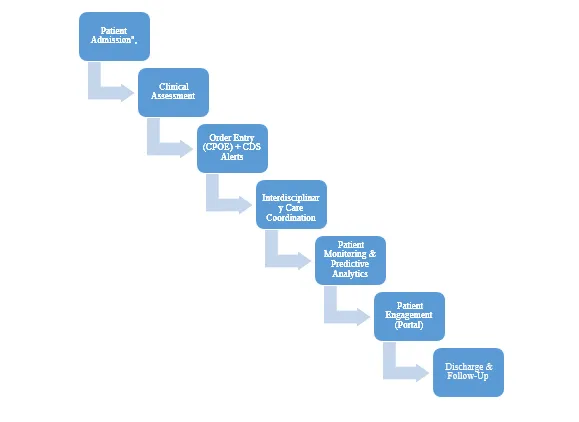
EHR is used as a platform for clinical, administrative, and patient-centred processes within the Massachusetts General Hospital in order to provide safe, efficient, and coordinated care. The current workflow begins at the admission stage, where demographic, insurance and medical history are recorded to guarantee proper baseline and continuity of care. This is followed by clinical assessment, where the vital signs, presenting complaints and medical history are input into the system by clinicians. The cross-checking of the data with the existing records in the system is conducted to identify allergies and comorbidities, and, therefore, reduces the risks of adverse effects. The orders are then created through the computerized physician order entry (CPOE), in which CDS tools, installed on the computers, provide warnings about potential drug-to-drug interactions or redundant therapy (Connelly & Korvek, 2023).
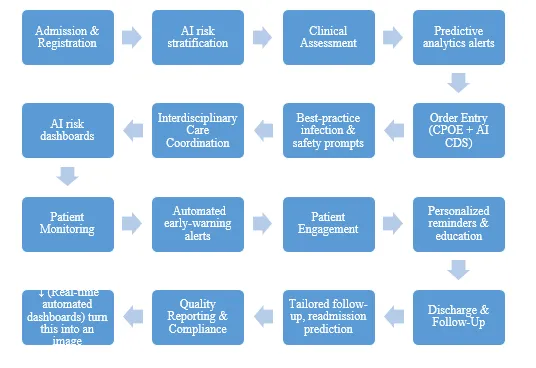
The record includes laboratory results, imaging and the outcomes of treatment, which make interdisciplinary communication less challenging and reduce redundancy or mistakes. Secure portals are used to provide engagement with patients to provide them with test results, schedule appointments, and communicate with providers. Quality and regulatory compliance, follow-up, and discharge are improved using digital care plans and automated quality reporting. Though efficient, the process remains reliant on static alerts and looking at the data retrospectively. The reconfigured workflow is a complement to the infrastructure by adding AI-based predictive analytics across the care continuum. Risk stratification of patients at the time of admission by AI algorithms selects the patients most vulnerable to complications such as sepsis or falls. Clinical measures are introduced into prediction models, which monitor vital signs and clinical measures in real-time, providing early notifications about the worsening and intervening in time.
AI is used in CPOE to facilitate CDS, such as the initiation of evidence-based interventions, such as infection-prevention bundles and fall prevention, thereby minimizing avoidable harm (Gohari et al., 2020). Interprofessional dashboards used to support care coordination include risk profiles and give the highest priority to the needs, and device-related monitoring provides real-time monitoring and advanced-warning notifications. Patient portals are personalized portals of engagement, which offer customized mobility reminders, infection-prevention education, and adherence reminders. Predictive analytics at discharge identify high-risk patients to be readmitted and design personalized follow-up plans. In contrast, automated dashboards summarize performance targets, such as sepsis, falls, and harm scores, and HIPAA and regulatory compliance. Overall, AI implementation changes the workflow towards a reactive one, which promotes timelier intervention, patient safety enhancement, and an improvement in patient outcomes. Appendix A gives the current workflow, whereas the AI-optimized redesign is provided in Appendix B.
Summary: Final Recommendations and Conclusion
The implementation of AI-based CDS within the EHR at the Massachusetts General Hospital has the possibility and the necessity. Though the SAFER framework focuses on well-established governance and system design, the methodology also brings up interoperability failures, workflow integration, and cybersecurity challenges, which should be addressed to ensure safety and performance. Predictive analytics implemented across the continuum of care would change the practice setting to proactive risk avoidance, such as mitigating sepsis, falls, and broken communication issues. Because of the effective leadership, the structured change management, and the adherence to the HIPAA requirements, MGH will be able to maximize patient outcomes, improve the safety culture and maintain the status of a nationwide leader in quality care and innovations.
Ace NURS FPX 9030 Assessment 4 with expert step-by-step guidance, practical tips, and proven strategies for top grades.
Step By Step Instructions to write
NURS FPX 8022 Assessment 4
Contact us to receive step-by-step instructions.
Instruction file for
NURS FPX 8022 Assessment 4
Contact us to get the instruction file.
Scoring Guide for
NURS FPX 8022 Assessment 4
Contact us to get the scoring guide.
References for
NURS FPX 8022 Assessment 4
Basil, N., Ambe, S., Ekhator, C., & Fonkem, E. (2022). Health records database and inherent security concerns: A review of the literature. Nih.gov. https://pmc.ncbi.nlm.nih.gov/articles/PMC9647912/
Cabello, C. A. G., Borna, S., Pressman, S., Haider, S. A., Haider, C. R., & Forte, A. J. (2024). Artificial-Intelligence-Based clinical decision support systems in primary care: A scoping review of current clinical implementations. European Journal of Investigation in Health, Psychology and Education, 14(3), 685–698. https://doi.org/10.3390/ejihpe14030045
Connelly, T. P., & Korvek, S. J. (2023). Computer provider order entry (CPOE). Nih.gov; StatPearls Publishing. https://www.ncbi.nlm.nih.gov/books/NBK470273/
Problems and barriers related to the use of ai-based CDSS: An interview study (preprint). Journal of Medical Internet Research, 27, e63377. https://doi.org/10.2196/63377
Gohari, S. H., Bahaadinbeigy, K., Tajoddini, S., & Kalhori, S. R. N. (2020). Journal of Pharmacy Technology, 37(1), 53–61. https://doi.org/10.1177/8755122520958160
Kotp, M. H., Ismail, H. A., Basyouny, H. A. A., Aly, M. A., Hendy, A., Nashwan, A. J., Hendy, A., & Abd Elmoaty, A. E. E. (2025). BioMed Central Nursing, 24(1), 56. https://doi.org/10.1186/s12912-024-02653-x
Kotter, J. (2025). The 8 steps for leading change. Kotter. https://www.kotterinc.com/methodology/8-steps/
NURS FPX 8022 Assessment 4 Quality Improvement Project Plan
Laurisz, N., Ćwiklicki, M., Żabiński, M., Canestrino, R., & Magliocca, P. (2023). International Journal of Environmental Research and Public Health, 20(3), 2416. https://doi.org/10.3390/ijerph20032416
LeapFrog. (n.d.). Massachusetts General Hospital – MA – Hospital Safety Grade. www.hospitalsafetygrade.org. https://www.hospitalsafetygrade.org/h/massachusetts-general-hospital
McGreevey, J. D., Mallozzi, C. P., Perkins, R. M., Shelov, E., & Schreiber, R. (2020). Reducing alert burden in electronic health records: State of the art recommendations from four health systems. Applied Clinical Informatics, 11(01), 1–12. https://doi.org/10.1055/s-0039-3402715
Medicare Compare. (2024). Find healthcare providers: Compare care near you | Medicare. Medicare.gov. https://www.medicare.gov/care-compare/details/hospital/220071?city=Boston&state=MA&zipcode=
O’Connor, S., Gasteiger, N., Stanmore, E., Wong, D. C., & Lee, J. J. (2022). Artificial intelligence for falls management in older adult care: A scoping review of nurses’ role. Journal of Nursing Management, 30(8), 3787–3801. https://doi.org/10.1111/jonm.13853
Papareddy, P., Lobo, T. J., Holub, M., Bouma, H., Maca, J., & Herwald, H. (2025). Critical Care, 29(1), 366. https://doi.org/10.1186/s13054-025-05588-0
Toseef, M., Kiran, A., Zhuo, S., Jahangir, M., Riaz, S., Wei, Z., Ghauri, T. A., Ullah, I., & Ahmad, S. B. (2022). Frontiers in Psychology, 13(846128), e846128. https://doi.org/10.3389/fpsyg.2022.846128
Appendices for
NURS FPX 8022 Assessment 4
Appendix A. Visual of the Workflow
Appendix B. Redesigned Workflow
Capella Professors to choose from for
NURS-FPX8022
JacQualine Abbe.
Sean Forster.
FAQ’s For
NURS FPX 8022 Assessment 4
Question 1: Where can I find assessment help for NURS FPX 8022 Assessment 4?
Answer 1: You can find assessment help for NURS FPX 8022 Assessment 4 at writinkservices.com.
Question 2: What is NURS FPX 8022 Assessment 4 Quality Improvement Project Plan?
Answer 2: Plan to improve healthcare quality using evidence-based strategies.
Previous Assessment: